The retail sector has undergone a major transformation over the past 20 years.
Today, shopping journeys are omnichannel, multicultural and multilingual. To reach their customers wherever they are, brands need to think globally whilst speaking locally.
In this context, retail translation has become a strategic asset in its own right, at the intersection of SEO, customer loyalty and brand consistency. An inaccurate translation can hinder conversions, tarnish your reputation or slow down your growth.
Conversely, a well-crafted, professional translation tailored to each market enhances your brand’s credibility, ensures your messages are conveyed effectively and boosts your sales performance.
In this article, we guide you through the key considerations, pitfalls to avoid and best practices for developing an effective and sustainable translation strategy for the retail sector in the age of international e-commerce.
CONTENTS
Why has investing in translation for the retail sector become a strategic priority?
A successful retailer no longer relies solely on a physical shop or a website in French. Today, retailers must manage multilingual online shops, international marketplaces, localised product catalogues, translated mobile apps… and ensure that all of this is consistent with their brand image. Every point of contact must offer a seamless, natural and reassuring experience, regardless of the language spoken by the customer.
A study CSA Research reveals that 76% of internet users prefer to shop on websites translated into their own language. And for 40% of them, language is a decisive factor in their purchasing decision. So, translating means selling – or at least increasing your chances of doing so. Investing in translation and expanding the range of languages you use directly boosts your ROI.
But it still needs to be done properly. Because this is not simply a matter of style or personal preference.
Let’s look at a few concrete examples.
Mango, a Spanish ready-to-wear brand with a strong presence in France, has launched a jewellery collection called ‘Esclava’. A common word in Spanish – it simply means ‘bracelet’ – but one that has a completely different connotation in French. It doesn’t take long to see what the problem is… and the controversy was soon upon us.
Another classic example: when Schweppes decided to launch its famous drink in Italy, one of the translations for ‘Schweppes Tonic Water’ ended up as ‘Schweppes Toilet Water’. A linguistic blunder that seriously damaged the product’s reputation.
This kind of mistake, although avoidable, can prove costly: damage to reputation, loss of revenue, or even the product being withdrawn from the market.
Conversely, a well-crafted, professional translation tailored to each market enhances your brand’s credibility, ensures your messages come across clearly… and boosts your sales performance.
The main challenges of retail translation
Ensure brand consistency across international markets
Expanding your business internationally involves more than simply translating your content using a machine translation platform. The stakes are much higher than that: it’s about conveying a consistent message that stays true to your brand’s identity in every target market.
The challenge? Striking the right balance between global standardisation and local customisation.
Humour, puns and cultural references don’t always translate well. And yet, it is often these elements that define a brand’s identity.
Achieving brand consistency on an international scale therefore means:
Develop a multilingual editorial policy,
Adapt the tone and style for each language, without compromising the brand’s identity,
Ensure consistent terminology,
And sometimes, completely reworking a message as part of a transcreation process
It is this attention to detail, in every language, that will ensure a seamless and consistent brand experience, whilst truly connecting with each customer wherever they are.
Accuracy and safety above all
Errors resulting from a retail translation can have very real, and sometimes serious, consequences : in legal, health or commercial terms. Technical data sheets, labels, user guides, safety instructions or allergen information…
One oversight, a poorly worded phrase or an inappropriate term, and the entire compliance of the product is called into question.
Certain local regulations require highly accurate translations, particularly in the food sector, cosmetics or textiles. Failure to comply with these requirements as a distributor may result in penalties, product recalls or even legal disputes. And beyond the legal aspects, it is consumer confidence that is at stake.
That is why technical translation should be entrusted to specialist professionals who:
have a good command of the technical vocabulary,
understand local regulatory requirements,
and make use of tools that ensure terminological consistency (translation memories, approved glossaries, etc.).
A recent example illustrates this well:
The Ülker brand has had to recall several products (biscuits, wafers, etc.) due to translation errors on the labels, which omitted essential information about allergens.
This incident serves as a reminder of just how essential accurate and compliant translation is, particularly when it comes to labelling and consumer safety in the retail sector.
Cultural adaptation
We may sometimes sound like we’re repeating ourselves, but this is a fundamental truth: translating retail content is not simply a matter of switching from one language to another. Above all, it is about adapting to a cultural context, local customs and unspoken norms that vary from one market to another.
An image, a catchphrase or a phrase that works well in France may be completely misunderstood — or even taken the wrong way — in Germany, Japan or Saudi Arabia. Every market has its own sensitivities, preferences and taboos. Ignoring these differences risks missing the mark… or worse, creating a negative buzz.
International SEO: boost your local visibility
Translating your content is a good start. But if your potential customers can’t find you in their own language on your website or marketplace, all your efforts may be in vain.
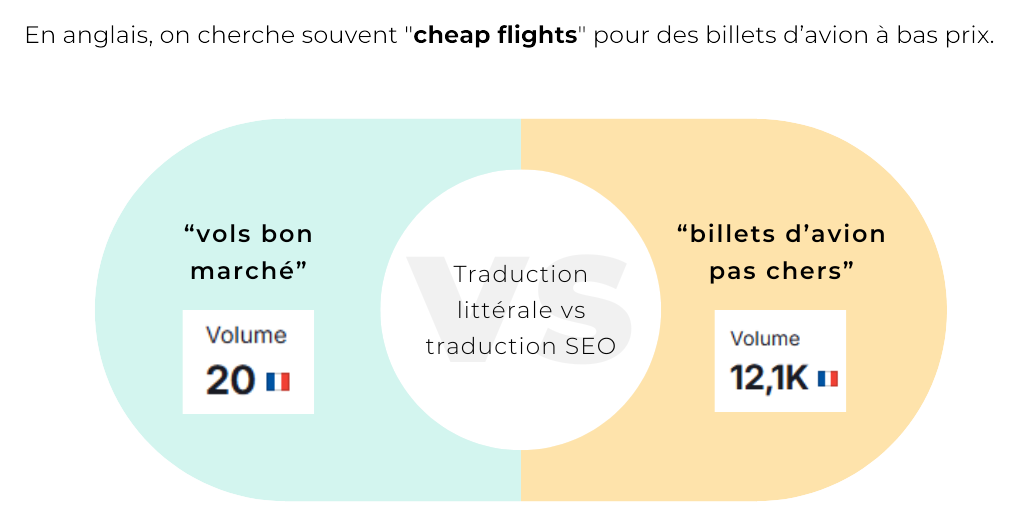
The International SEO is a key component of any international retail strategy. Although it is still too often overlooked, it nevertheless requires a genuine adaptation — not only of the content, but also of its technical structure. It is not enough simply to translate keywords: they must be reimagined for each market, taking into account local customs, the dominant search engines and cultural expectations.
Let’s take another example:
This example shows that a literal translation of an English keyword often has no impact on SEO in French. Without local semantic analysis, your product listing or campaign may be perfectly translated… but impossible to find on Google.
An effective multilingual SEO strategy therefore involves:
A dedicated keyword search by language and country;
Optimisation of all tags (title, meta, URL, ALT, etc.);
A well-designed technical structure, including management of hreflang tags and localised sitemaps.
It is this combination of localised content and a well-structured layout that enables you to be truly visible, everywhere.
Are you wondering what the best approach is for managing your translations in 2026?
We’ve seen what not to do: misunderstandings, cultural faux pas, compliance issues, SEO oversights…
But now, let’s get down to business: how to do it properly.
What approaches should be adopted to ensure that retail translations are reliable, natural and effective in every market?
There are several ways to go about this, depending on your internal resources, your objectives and your level of international maturity. Here are the main ones.
Building on the synergy between people and technology
Today, translation solutions for translationthe most effective ones are based on a smart balance between human expertise and technological tools : Depending on the specific requirements of the translations, the extent of human involvement varies. It ensures accuracy, conveys emotion, captures idiomatic expressions and ensures cultural appropriateness. Conversely, translation tools significantly speed up translation times and enable the processing of large volumes.
Structuring your project management
A good translation also relies on a well-oiled organisational process, with a clear brief for each target market, established workflows (translation > proofreading > integration), and, where possible, CMS/PIM integrations to automate certain steps (such as WPML).
It is these processes that ensure the quality, speed and consistency of your content on an international scale.
Thinking omnichannel
For a long time, the translation focused on the e-commerce. Today, it must be part of an omnichannel approach that is consistent at every point of contact with the customer. Reusing translated content across all channels and at every touchpoint is becoming essential for moving quickly and keeping costs under control, whilst remaining true to your brand image and strategy.
Having a comprehensive translation strategy for the retail sector also means considering localisation:
chatbot scripts, customer service FAQs and product manuals.
And above all: all the high-value content that contributes to your brand image and your commercial performance.
This complexity requires centralised management of multilingual content: message alignment, consistent tone, consistent terminology and content reuse.
Above all, an organisation capable of bringing together the e-commerce, marketing, product and customer service teams around a single global localisation strategy.
Outsource to a specialist partner
If you’re looking to save time whilst ensuring the quality of your multilingual content, the most reliable solution is to use a translation agency specialising in retail translation.
That is precisely what EuropaTrad offers:
A comprehensive service for your projects, from translation to integration, including:
translators specialising in your sector, with robust proofreading and validation processes,
proven multilingual SEO expertise,
The tools and expertise to ensure the maximum use and reuse of existing translations
and the ability to work directly with your internal systems.
The aim: to free you from operational constraints whilst ensuring your content performs effectively in every market.
Wrapping Up
An international retail strategy cannot be improvised. Behind every product description, every marketing message, every label or piece of SEO content, the quality of the translation plays a key role.
If poorly designed, it can hinder your conversions, tarnish your reputation or lead to costly mistakes. But when implemented effectively, it becomes a powerful tool: to boost your sales performance, streamline the customer experience, and secure your international expansion.
Retail translation is a delicate balance between understanding local market dynamics, maintaining global brand consistency, and mastering the most advanced linguistic tools. Above all, it’s a question of method.
Let’s work together!
Would you like to assess your needs and discuss your translation strategy?