E-learning is a powerful tool for training teams around the world. But to be truly effective, training must go beyond mere translation and be tailored to the cultural and technical specificities of each market. That is precisely what is at stake in the e-learning localisation.
You may have the best e-learning course, but if it isn’t properly adapted to the language and culture of your target audience, its effectiveness will be reduced. This can lead to a loss of engagement and limit the impact of the learning experience, which is certainly not your aim.
In this article, we will look at what e-learning localisation is, why it is essential for your online training courses, and what best practices to adopt to deliver a learning experience that is truly tailored to an international audience.
CONTENTS
What is e-learning localisation?
Definition of e-learning localisation
The e-learning localisation is not limited to translating the content of a training course. This involves adapting all educational and technical elements to ensure a seamless and effective learning experience, regardless of the target market. This includes:
✅ Linguistic adaptation : accurate translation tailored to the cultural context.
✅ Adaptation of multimedia content : videos, images, infographics and voice-overs adapted to local standards.
✅ Taking educational differences into account : certain learning methods vary from country to country.
✅ Technical optimisation : compatibility with e-learning platforms and formats commonly used in each region.
The difference between translation and localisation
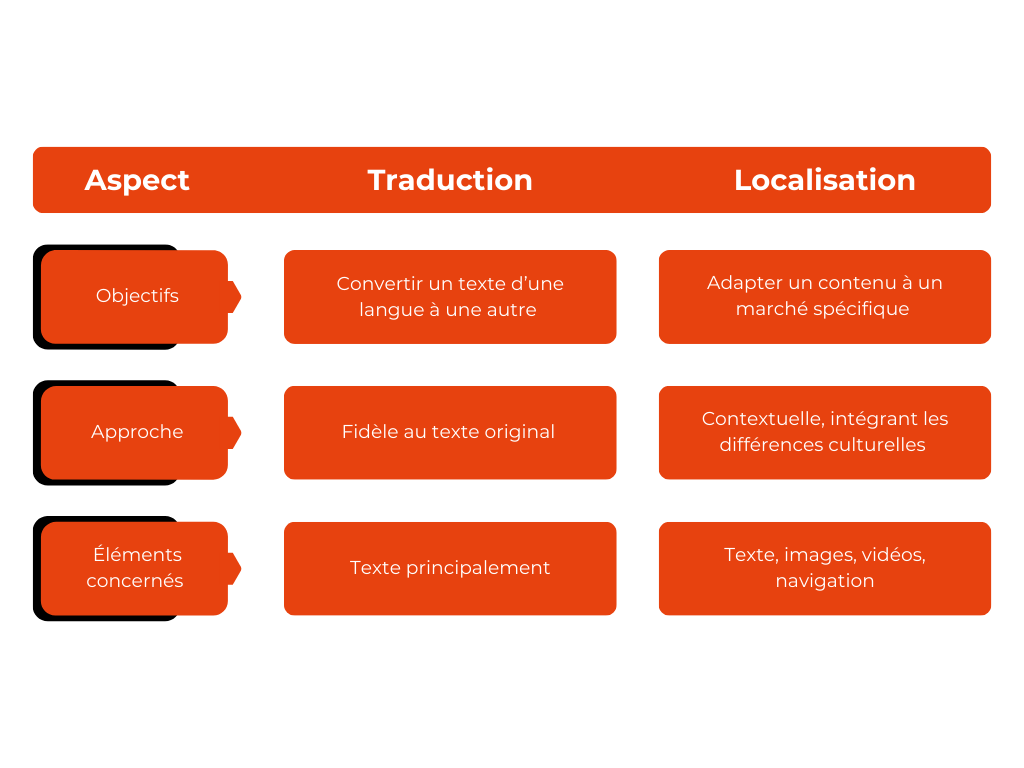
Translation and localisation are often confused, yet these two concepts are quite distinct:
In short, the translation focuses on the process of transposing a text from one language into another, whereas localisation aims to fully immerse the learner inits cultural context.
Why is localisation essential for your online training courses?
The benefits of e-learning localisation
Investing in e-learning localisation helps maximise the impact of your international training programmes. When content is tailored to the learners’ language and culture, it becomes more engaging and easier to absorb. Training tailored to specific regions also boosts your credibility by demonstrating that you take into account the unique characteristics of each of your markets. By offering a more seamless and intuitive learning experience, you improve understanding and encourage greater uptake of knowledge.
Beyond the user experience, localisation also plays a strategic role for your business. It enables you to reach a wider audience and make your training courses available to more employees or customers. This way, you maximise the effectiveness of your programmes and ensure a better return on investment.
A catalyst for your international expansion
A well-localised e-learning course does more than simply impart knowledge: it becomes a genuine catalyst for growth. By making your content accessible and relevant to different markets, you make it easier to engage new audiences and accelerate your international expansion.
The consistency of training programmes is also a key issue for multinational companies. By adapting the modules to each language whilst maintaining a consistent approach, you ensure effective skills development for your teams, regardless of the country in which they are based.
Furthermore, a company that invests in e-learning localisation strengthens its brand image by demonstrating its commitment to its employees and customers, wherever they may be.
Are you looking to roll out your e-learning courses internationally?
To ensure simple and effective localisation, you must plan for adaptation right from the design stage of your e-learning course. Well-structured content, written in clear language and free from expressions that are too culturally specific, makes the localisation process easier. It is also advisable to avoid overly idiomatic expressions, local references, or puns that are difficult to translate into other languages. Unless you like making things difficult for yourself?
Optimising multimedia content is another key point. The images, videos and activities must be tailored to the target audience, both linguistically and culturally. For example, a video with subtitles should be designed to allow sufficient time to accommodate longer text in certain languages.
Ensuring consistency in terminology
A localised e-learning course must maintain linguistic consistency across all the content presented to learners to avoid any confusion. The use of a glossary (term base) and a translation memory(translation memory) enables the standardisation of technical terms and expressions specificspecific to your field of activity or your company. This approach ensures a better understanding and enhances the credibility of the content.
Challenges in e-learning localisation and how to overcome them?
Managing technical constraints
E-learning localisation involves the adaptation of various multimedia elements, each presenting specific technical challenges. Modern online training courses incorporate images, sound, text, animations and videos in a creative and effective way, requiring a distinct approach for each component.
Text One of the first challenges concerns thetext text. Some languages,such as German or Spanish, take up to 30% more space than English. This maycause display issues in menus, navigation buttons orimage captions. You must also ensure that the fonts used support all the relevant languages. Il it is necessary to anticipate these variations bydesigning flexible interfaces that are suitable for multiple languages.
Audio and video Theintegration of audio and video elements is also a major challenge. A recorded voiceover will need to be synchronised with the original animations or videos, whilst the addition of subtitles will require careful adjustment to ensure they are easy to read. The choice between Date : subtitling, the voice-over using a synthetic voice orthevoice-over in human voiceewill depend on cultural preferences andyour localisation budget.
Interactive elements Finally, the interactive elements, such as quizzes or practical exercises, need to be redesigned to remain relevant in each language. Similarly, date formats, units of measurement and currencies must always be adapted to avoid any confusion.
By taking these technical aspects into account right from the design stage of the training programme, it is possible to streamline the localisation process and enhance the user experience, whilst ensuring optimal consistency across all target markets.
Targeting the right languages and keeping costs under control
The most common mistake in e-learning localisation is to assume that English is sufficient to reach an international audience. However, although English is widely spoken, many learners prefer to study in their mother tongue.
The choice of languages must therefore be strategic. There’s no need to translate your training materials into every possible language: focus on those that correspond to high-potential markets and your target audience.
When it comes to budget management, this presents a real challenge in e-learning localisation. A good way to keep costs down is to combine all languages into a single order, which reduces technical costs and simplifies management. Furthermore, working with a single service provider capable of handling everything – translation, voice-over, subtitling, video synchronisation and format adaptation – ensures a smoother process and reduces turnaround times.
Wrapping Up
E-learning localisation is not merely a matter of translating your training courses: it is a strategic tool for making them accessible, engaging and effective on an international scale. A successful adaptation not only enhances the learner experience, but also strengthens the impact and consistency of your training programmes across different markets.
One key point not to be overlooked: the centralisation of your localisation. By entrusting the entire project to a single service provider or a dedicated and qualified team such as EuropaTrad, you ensure consistency in terminology and style across all media. This centralised approach also makes it easier to coordinate the various stages, from the translation of text content to the adaptation of multimedia elements, including proofreading and final testing.
Whether you are in the roll-out phase or looking to optimise your existing modules, investing in a well-planned, centralised localisation process is the key to maximising the reach and effectiveness of your e-learning internationally.
Let’s work together!
Would you like to assess your needs and discuss your translation strategy?