Choosing a provider of translation services has never been so complicated. Freelancers, specialist agencies, automated platforms… The choice is vast, the promises are plentiful, and it’s often difficult to compare them.
Especially since, by 2026, the criteria for choosing a provider will no longer be limited to price or delivery times alone. AI integration, data security, CSR commitments, accessibility standards… The challenges have multiplied, and require an approach that is even more strategic than it already was.
That is why it is essential to clearly define your actual needs, prioritise your objectives and structure your call for tenders for language services in a systematic manner. In this article, we’ll guide you step by step to help you make the right choices and find a translation partner that matches your ambitions.
CONTENTS
Why are translation services strategic for businesses?
Multilingual content at the heart of competitiveness
In a world where growth increasingly depends on international expansion, the ability to manage multilingual content has become a key driver of competitiveness. Whether you’re responding to a tender, launching an e-commerce site, communicating on social media or training teams abroad, translation services ensure that your messages reach your target audiences accurately, and are therefore not merely an expense.
The figures speak for themselves: according to CSA Research, 76% of consumers prefer to shop in their own language and 40% never shop on a website that hasn’t been translated.
Conversely, poorly translated content can not only damage your reputation, but also lead to additional costs (delays caused by numerous corrections, misunderstandings, and a loss of credibility). A well-structured translation strategy, on the other hand, helps to speed up your time-to-market, ensure consistency in your communications and safeguard your dealings with your international partners.
Translation: much more than just a linguistic transfer
Modern translation services go far beyond mere linguistic translation. The aim is to tailor a message to a specific sector, purpose and cultural context. Today, they cover a much broader range of services than simply document translation. These include website and app localisation, international SEO to improve search engine visibility, transcreation to adapt a marketing message, as well as subtitling and voice-over for audiovisual content.
The most advanced service providers also offer support for complex technical formats (CMS, PIM, DAM, etc.), delivering files that your teams can use straight away.
This development places translation at the heart of your communication strategy. Agencies capable of combining industry expertise, technological support and project management thus become true partners to accelerate and safeguard your international expansion.
Buying translation services in 2026: what’s changing
The rise of AI and post-editing
By 2025, AI had become the norm in the translation industry. Machine translation engines enable large volumes of text to be processed quickly, but they are not enough to guarantee professional-quality results. This is why post-editing has become an essential step: a translator reviews the text produced by the machine, corrects it, adapts it and ensures that the result is consistent with the context, the brand’s tone and local conventions.
There are generally two approaches:
a quick post-editing service suitable for simple or internal content (such as FAQs or non-critical technical documentation),
post-editing integrated into a comprehensive translation process, which is essential for strategic documents such as contracts, marketing materials or regulatory publications.
At EuropaTrad, we offer two solutions tailored to these needs:
Premium
AI machine translation
It is ideal for large volumes or low-stakes content, with systematic human oversight to prevent errors and misinterpretations.
AI is thus transforming the role of the translator, who is now responsible for ensuring quality and consistency, rather than simply producing text. Used effectively, this “AI + human” combination helps to reduce costs and lead times, whilst safeguarding the value of your content.
At the same time, some companies are opting for a ‘100% AI’ approach to their international communication strategy, using AI translation platforms, which enable a large part of the process to be automated. They offer numerous practical benefits (time savings, reduced costs, integration into workflows), but bear in mind that they perform much better if they are properly configured using tested and accurate terminology, and they are not suitable for all projects.
Whether the content is strategic, legal or creative, failing to proofread it can lead to errors with serious consequences.
That is why we advise you to use these technologies with care, as they can be an asset in certain situations, but must always form part of a translation strategy tailored to your specific needs.
Translation agencies are becoming "Global Content Services Providers"
In line with these developments, translation agencies are continuing their transformation to become true “ Global Content Services Providers ”, in other words, “global content service providers”. But in practical terms, what does that mean for you? And above all, what is actually changing?
Their role is no longer limited to translation; they manage the entire lifecycleof your multilingual content. This includes translation and proofreading, of course, but we also offer:
the configuration of your translation systems, whether or not they are integrated into your applications and systems,
integration via API,
international SEO,
app localisation,
marketing transcreation,
as well as subtitling, voice-overs and compliance with accessibility standards.
This development meets the needs of businesses: they want a single partnercapable of managing their multilingual projects from start to finish, rather than having to deal with multiple service providers. The benefits are twofold: greater consistency in content and better control over costs and deadlines.
New purchasing criteria: CSR, safety, AI and accessibility
Today, new purchasing criteria are coming into play and making a difference in your tenders:
CSR : Under the CSRD (Corporate Sustainability Reporting Directive), large European companies have been required to publish detailed reports on their social and environmental impacts since 2025. Furthermore, as of this year, the Climate and Resilience Act will require public procurers to include at least one CSR criterion in their calls for tenders.
Accessibility : with theEAA (European Accessibility Act) and the French RGAA (General Framework for Improving Accessibility), service providers must deliver compliant content (accessible PDFs and websites, subtitled videos, etc.).
Security and AI : the protection of sensitive data and the responsible use of AI now go hand in hand. TheEU AI Act requires greater transparency and regulation: a key point to discuss with service providers.
Choosing the right translation provider also means checking that they are capable of meeting these new requirements whilst ensuring the expected quality.
2. What questions do you have to ask yourself before launching your translation tender?
Before publishing your call for tenders, there are a few questions you should ask yourself to ensure your requirements are clearly defined. Here are some of those questions:
What are the key topics and priorities? Not all your projects involve the same level of complexity or the same budget (websites, contracts, marketing materials, internal documentation, etc.).
What information systems and applications do you use? CMS, PIM, DAM, document management systems… specifying the tools you use helps ensure that the service provider will be able to integrate with them.
What languages, volumes and realistic deadlines? Identifying your language combinations, peak periods and deadline constraints helps to estimate the workload and costs.
What are the security and data management requirements? Privacy, data storage, the use of AI… it’s best to clarify your policies in advance.
Which selection criteria should be prioritised? Language quality, pricing (subscriptions, per page or per word), sector-specific expertise, CSR, accessibility: it’s up to you to set your priorities.
By asking yourself the right questions from the outset, you’ll save time when drafting your specifications and make it easier to evaluate the tenders received.
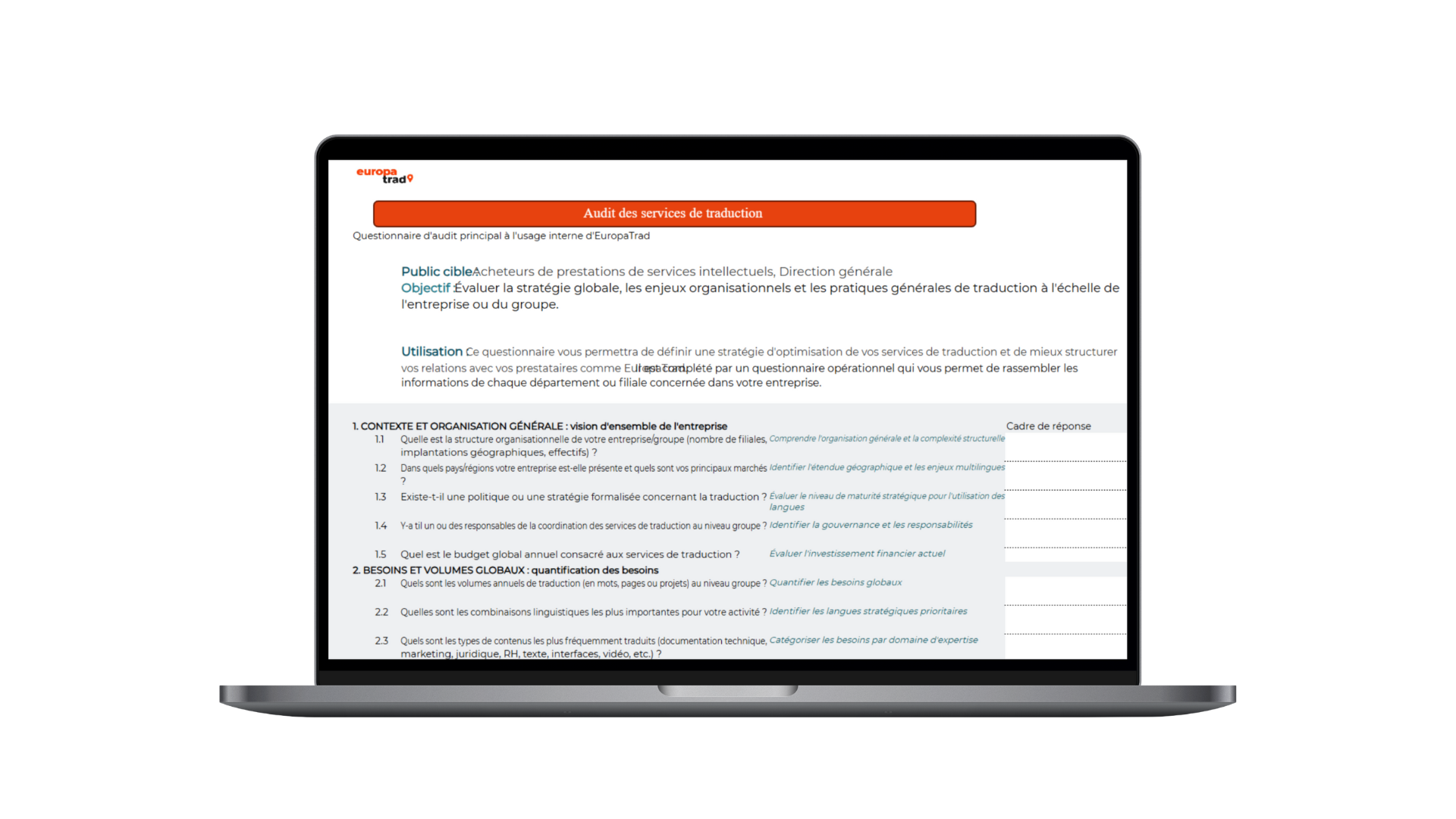
And if you’d like to take things a step further, take a look at our translation services audit kit, designed to help you analyse your current practices, identify your priorities and structure your tenders effectively.
3 Our advice and tips for structuring your invitation to tender
A successful translation tender relies first and foremost onsector-specific expertise : opt for a translation agency whose translators work into their native language and have a thorough understanding of your field (legal, technical, medical, marketing). Certifications also demonstrate a commitment to rigorous quality control and project management.
At EuropaTrad, we have held the ISO 9001 standard since 2006. It ensures the consistency and quality of the services offered to clients. This standard is based on several quality management principles and enables us to offer a well-established process.
Also assess the technological capability from the service provider: APIs and integration with your tools (CMS, DAM, CRM), the ability to build and deliver comprehensive translation workflows, management of translation memories and glossaries, the tools used, and the controlled use of AI… These elements ensure smooth, secure processes that are tailored to your organisation and your specific needs.
Please feel free to ask the agencies you are considering to complete a translation test (200 to 400 words) using a representative sample of your content. It’s a good way to assess linguistic quality, mastery of terminology and alignment with your company’s tone.
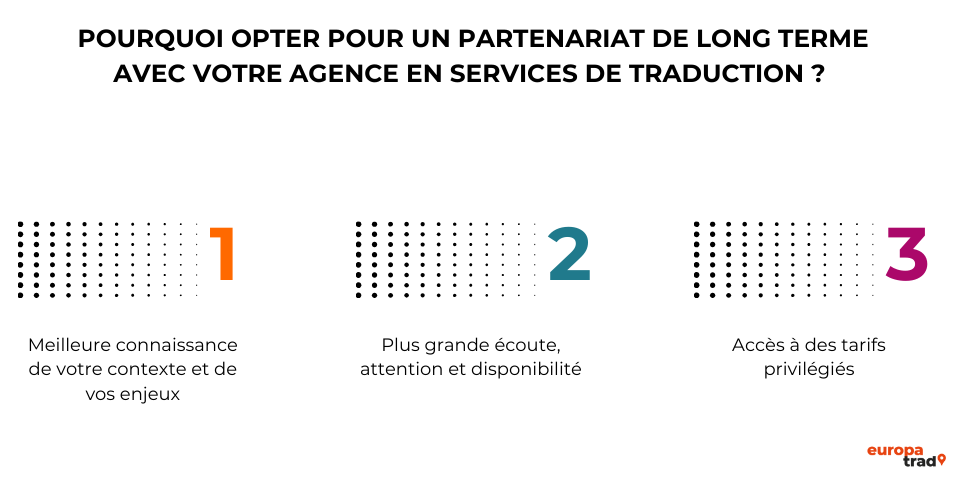
Finally, think long-term partnership. Working with the same service provider allows you to make the most of your content, ensure consistency and reduce costs. Transparency regarding methods and regular communication are the cornerstones of a sustainable and effective partnership.
In summary
Centralising your translations helps to avoid wasted time and inconsistencies. With EuropaTrad, those headaches are a thing of the past: with a single point of contact for all your language projects, you come out on top!
Translation costs vary depending on your requirements and resources and also the practices employed by your service provider.
Clarify your requirements and expectations: the more clearly you define your needs (content, quality standards, deadlines), the better equipped you will be to choose the most suitable solution from those offered by your service provider.
The price must not be a barrier but be seen as a worthwhile investment thanks to a long-term translation strategy with the partner.
Translation services are no longer limited to translation itself, but must be integrated and designed to fit your organisation’s workflows and digital tools.
Compliance with legal obligations is essential (CSRD, RGAA, AI Act, etc.). Your service provider must be able to assist you in meeting these requirements.
Let’s work together!
Would you like to assess your needs and discuss your translation strategy?