Even if your website ranks well in France, that doesn’t necessarily mean it does so elsewhere. International SEO helps you optimise your visibility on search engines and reach new audiences abroad. Every language and every market has its own search habits and cultural characteristics.
Is this concept still a bit unclear to you, and would you like to learn more so that you can develop your own international SEO strategy? This article is just for you!
CONTENTS
What is international SEO?
Definition of international SEO
International SEO involves optimising a website so that it ranks highly in multiple languages and across various international markets. Unlike a simple content translation, this approach takes into account the linguistic, cultural and technical specificities of each target country.
What’s the aim? Improving a website’s visibility by adapting to the search habits of each market.
International SEO or multilingual SEO: what’s the difference?
These two terms refer to the same process: optimising the content ofa website, in the target languages, for effective international search engine optimisation. Whether we’re talking about multilingual SEO or international SEO, the aim remains the same: to adapt the content, structure and SEO strategy to the target languages and markets.
Why is international SEO essential for your website?
Having a high-performing website in your own language, and translated into other languages, is a good start. But that’s not enough to succeed internationally. Every country has its own search habits, keywords and SEO criteria. Without the right strategy, you risk missing out on numerous opportunities for traffic and conversions.
You might as well stack the odds in your favour, shouldn’t you?
The benefits of international SEO
Greater international visibility → Your website is optimised to appear in local search results.
More targeted traffic → You attract visitors who are genuinely interested in your products or services in every language.
An improved user experience → Content that is tailored to local expectations and preferences boosts engagement.
A higher conversion rate → Well-optimised pages tailored to users increase your chances of turning visitors into customers.
In short, a good international SEO strategy enables you to expand your audience and maximise your impact in foreign markets.
Key steps for successful international SEO translation
Identify your target markets
Before optimising your website, take the time to identify the countries and languages in which you want to be visible. This decision isn’t made at random: take into account your current sales or distribution agreements, but also analyse your current web audience to identify the countries that are already generating traffic and assess their potential.
Bear in mind that customer behaviour varies from one market to another. A product that is in demand in France is not necessarily in demand in Germany or Japan. Targeted market research will help you gain a better understanding of local demand, trends and the competition.
And don’t forget that SEO practices vary from country to country. In China, for example, Baidu is the dominant search engine, with rules that are very different from those of Google. It’s best to plan ahead for these specific circumstances!
Would you like to optimise your SEO for an international audience?
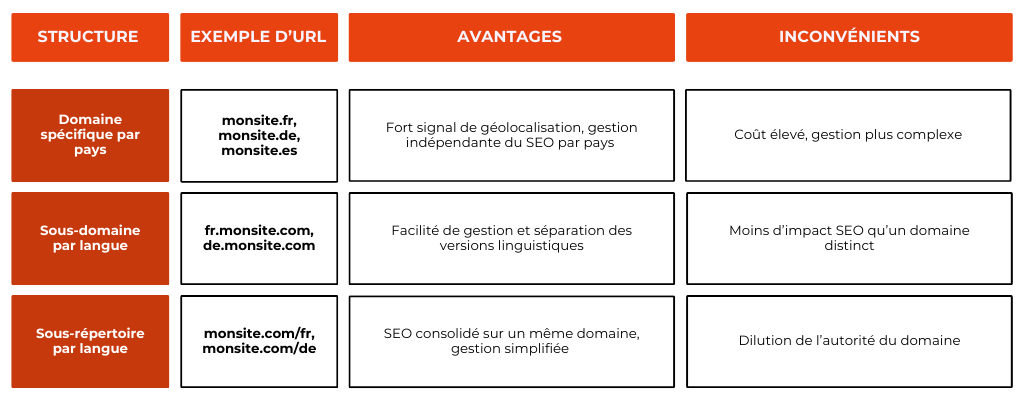
The structure of your website plays a key role in international search engine optimisation. There are three main strategies:
The choice of structure depends on your budget, your objectives and the technical resources available. The subdirectory structure–is generally considered the best option for international websites. It will enable you to organise your multilingual content more effectively whilst maintaining the authority of your main domain, which will benefit your website’s overall search engine optimisation.
Finding the right keywords for each language
Don’t fall into the trap of translating your keywords word for word! When it comes to international SEO, each market has its own conventions and search habits.
So how can you be sure you’re targeting the right keywords? To identify the most relevant keywords for each market, use free tools such as Google Keyword Planner or paid tools such as Semrush, Ahrefs or even Ubersuggest, it will depend on the budget you wish to allocate to SEO.
If you’d like more advice, check out our blog post on SEO translation.
Common mistakes to avoid in multilingual SEO
To settle for a translation produced by AI
In the age ofartificial intelligence, it is tempting to entrust the translation of one’s website to automated tools such as Google Translate or DeepL, or to translation tools built into web publishing software. Fast, accessible and increasingly effective, these solutions appear to offer considerable time savings. That’s true when it comes to providing content in multiple languages, but when it comes to multilingual SEO, it’s not enough.
As mentioned earlier, search engines aren’t satisfied with a word-for-word match, and neither are your users. Every market has its own expressions, search habits and cultural references.
Incorrect configuration of hreflang tags
The hreflang tags are a key technical element in international SEO. They tell search engines which language version of a page to display based on the user’s language and region. It is therefore essential to check that the translated and SEO-optimised pages contain hreflang tags and that these correctly specify the language (in ISO 639-1 format). And even better, the locale (in ISO 3166-1 alpha-2 format)
In theory, implementing them seems straightforward. In practice, this is often where things go wrong. Incorrect configuration may result in:
Poor indexing, with page versions appearing in the wrong countries.
A duplicate content issue, if Google cannot determine which version to prioritise.
A substandard user experience, if a Spanish user comes across an English version when a Spanish version is available.
Failing to adapt content to the local culture
Translating your website without taking local linguistic and cultural characteristics into account can lead to a number of problems:
Inappropriate tone : Some countries prefer a direct and concise style (e.g.: (United States), whilst others prefer a more formal and detailed tone (e.g.: (Japan, Germany).
Misunderstood references : Idioms, puns or local references may lose their meaning or even be taken the wrong way in another country.
Irrelevant visuals : An image that works in one country may not be appropriate elsewhere, whether for cultural or symbolic reasons.
But how can you avoid making all these mistakes?
Choose a translation agency specialising in SEO
Here’s how to avoid these mistakes. But optimising a website for multiple markets involves more than just avoiding the usual pitfalls: it requires a comprehensive and coherent strategy. That’s where a agency for SEO translation, a key partner for developing your international search engine optimisation.
Optimised multilingual management Simply translating content isn’t enough: you need to find the right keywords, adapt the website’s structure (hreflang tags, URLs, internal linking) and ensure semantic consistency across every language version.
A complementary approach to your SEO agency: From optimising the CMS configuration for different languages to creating localised content, an SEO translation agency handles the critical aspects of multilingual SEO to ensure maximum visibility.
By engaging a translation expert such as EuropaTrad, you can be sure that your website is optimised for each target market and that your international SEO strategy is effective and sustainable.
Wrapping Up
Expanding internationally isn’t something you can just wing, and SEO plays a key role in this expansion. A well-thought-out international SEO strategy enables to boost your visibility, attract targeted traffic and enhance the user experience in each market.
But between language management, technical optimisation and cultural adaptation, there are many challenges. By avoiding common mistakes and relying on international SEO experts, you’ll give yourself the best possible chance of success.
Let’s work together!
Would you like to assess your needs and discuss your translation strategy?